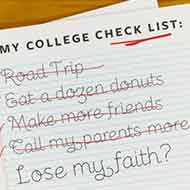
Research and Trends
InterVarsity
is developing a new style of campus ministry that doesn't rely on campus structures in response to being booted from California State University campuses, America's largest university system. "Our campus access challenges give this generation of students an opportunity to reinvent campus ministry," stated Greg Jao, InterVarsity's national field director.
(
Christianity Today, 9/9/14
)
Unchurched "Shoppers" Rate Churches
- Over six years, more than 4,000 unchurched mystery guests visited churches of all sizes across the U.S. They found that churches with fewer than 80 people in attendance often don't do well with children's ministries or having information available, but they lead the pack in greeting guests upon arrival, the pre- and post-service atmosphere and friendliness. Megachurches fared best overall. Churches with 1,000 members or more ranked top in 10 of the 16 categories, including raising awareness of the church in the community, seating arrangements, message delivery and the pastor's public speaking skills. All church sizes scored "very poor" - 5 to 6 out of 10 - in diversity and outreach. Except for megachurches, churches also scored poorly on the likelihood that mystery guests would return based on their first impression.
(
Christianity Today, 6/27/14
)
Church Can Help You Love Your Job
Baylor Univ. research claims frequenting a church that teaches God is present at your workplace, work is a mission from God, or faith can guide work decisions and practices, is a good for a career. Those who often attend churches with that philosophy are more likely to be committed to their work, be satisfied with their work and look for ways to expand or grow the business.
(
CT Gleanings 7/16/14
)
College Education Doesn't Always Equal Religious Decline
A Univ. of Nebraska sociological study undermines the common conception that with advanced education comes a general loss of religious affiliation. To the contrary, those with the least amount of higher education were more inclined toward religious non-affiliation than those with more years of higher education. Research on young adults over the last few years has suggested college education is not as correlated with religious decline as it had been in older studies based on samples of Baby Boomer and previous generations of Americans. Regarding the cultural phenomenon of college as a place where religious belief declines, researcher Phillip Schwadel says there were multiple factors as to why people assume this. "First, it was true of older generations. Second, the curricular, cultural and social content of higher education does sometimes conflict with religious beliefs and perspectives. Third, it is easy to blame 'liberal professors' and the university system more generally for religious decline, when in fact religious decline is relatively likely at that stage of the life course regardless of education."
(Social Forces 8/14)
The Religiously Unaffiliated
are nearly half as likely vs. the religiously engaged to say "a community of people who share your values and beliefs" is important (28% and 49% respectively).
(Focus on the Family Findings 8/13)
Getting to Church
According to a Pew Research Center study, 24% of religiously affiliated Americans mention practical difficulties, including work conflicts, as a barrier to church attendance. Of church attenders (not just those who identify with a religion), more than a quarter say their work schedules make it difficult for them to regularly participate in congregational events. Secularization of Sunday (e.g., children's sports programs and school-related activities) also distract from regular church attendance.
(
CT Gleanings 7/16/14
)
How Americans View Religious People
According to a Pew Research Center survey, Jews, Catholics and evangelical Christians receive an average "feeling thermometer" rating (on a scale of 0 for "cold, negative" to 100 for "warm, positive") of 60 or higher: 63 for Jews, 62 for Catholics and 61 for evangelical Christians. 44% of the public rates all 3 at 67 or higher. Buddhists, Hindus and Mormons ranged from 48 for Mormons to 53 for Buddhists. Atheists averaged 41 and Muslims 40. 41% of the public rates Muslims 33 or below and 40% rate atheists even lower.
(
Pew Research Religion & Public Life 7/16/14
)
How Religious People View Others
Religious groups are viewed more positively by their own members than by people from other religious backgrounds. Catholics as a group, for example, rate 80 (on a 0 to 100 scale) from Americans who describe themselves as Catholic vs. 58 from non-Catholics. Similarly, evangelical Christians average 79 from people who describe themselves as born-again or evangelical vs. 52 from non-evangelicals. Among non-evangelicals, 27% give evangelicals a low rating while 30% give them a high rating. Both Jews and atheists rate evangelicals negatively, but evangelicals rate Jews highly.
(
Pew Research Religion & Public Life 7/16/14
)
Jews Viewed Amiably by Americans
In a new Pew survey, respondents reported feeling more warmly toward the chosen people than those of any other faith. Despite making up only 2% of America's population, Jews ranked at the top Pew's "feeling thermometer." Outside of New York City, Jews are generally rare in terms of numbers. Yet in spite of this and historic widespread anti-Semitism, they've become seen as normal (and popular) by the population at large.
(The Atlantic 7/16/14)
Why Evangelicals Are Unliked
Over the last 30 years, the Religious Right has replaced Christianity's foremost message of the Gospel with that of a political movement, argues Billy Graham's grandson and Florida pastor Tullian Tchividjian. His response is to a new Pew Research study which suggests only 30% of non-evangelical Americans feel warmly about this religious group. "Specifically the reason why evangelicals in America are unliked by non-evangelicals is because we've branded ourselves as a political movement. It's not like Christians don't have opinions about what's going in our world and what's happening in our culture; I think that we do. I do; we all do. But when the primary message the world hears from us is 'We need to fix the world ... we need to stamp out all of the bad stuff,' they don't hear the message that Jesus has entrusted to us," notes Tchividjian.
(
Christian Post 7/18/14
)
Culture and Opportunity
In its inaugural Index of Culture and Opportunity
, the Heritage Foundation examined 31 indicators in areas of culture, general opportunity, poverty and dependence. The indicators examined include the abortion, marriage, divorce, total fertility, high-schooler abstinence and religious attendance, as well education and social welfare spending. America is on the right track in only eight areas. One is the abortion rate, which dropped by 4 per 1,000 women of childbearing age between ‛01 and ‛11, the lowest rate since 1973. Also, while the marriage rate has dropped by 10.3 per 1,000 women 15 or older in the last decade, the divorce rate remained relatively stable, decreasing by 0.4 per 1,000 people. Approximately 50% of the nation's adults are married, and about half of our children will spend some time outside an intact, married home. The unwed birth rate increased by 6.7 percentage points from ‛02 to ‛12. On the rise is the number of single-parent households, which increased 0.3 percentage points. Of particular concern is America's continued declining fertility rate. Religious attendance is also on the decline. From ‛02 to ‛12 the percentage of Americans who attend religious services on a weekly basis dropped by one percentage point, down by more than 10 points in the last 40 years, while the percentage of those who "rarely/never" attend has increased from below 30% in the early ‛70s to well over 40% in ‛12.
(
LifeSite News 7/31/14
)
Who's Reading?
According to recent Barna Group research, practicing Protestants are the big readers. They are more than twice as likely (21%) as those of other faiths (11%) and no faith (8%) to have read two of the polled books. They also outpace practicing Catholics, 10% of whom say they finished two books.
(
Barna Group 8/6/14
)
Russia Censors Films
Russia has outlawed swear words in films, theatre and the media. The legislation, signed by President Vladimir Putin, imposes hefty fines on offenders (up to 2,500 rubles or $79) for individuals and 50,000 rubles or $1,590 for businesses). The measure comes amid the growing influence of the Russian Orthodox Church as well as government calls to protect the Russian language in conflict-torn Ukraine. But critics say the ban is the latest in a line of clampdowns on freedoms and accused the parliament of hypocrisy since the country's top leadership is believed to resort to curse words in private.
(9 News 7/11/14)
Head of State Required Religion
30 of the world's countries (15%) belong to a unique group of nations that call for their heads of state to have a particular religious affiliation, finds new Pew research. From monarchies to republics, candidates (including descendants of royal monarchies) in these countries must belong to a specific religious group. More than half of the countries with religion-related restrictions on their heads of state (17) maintain that the office must be held by a Muslim. Two countries, Lebanon and Andorra, require their heads of state to have a Christian affiliation. Nineteen other nations have religious requirements for ceremonial monarchs who serve as their heads of state. Most of the world's countries (85%) allow citizens of any religious affiliation to be head of state.
(
Pew Research Center 7/22/14
)
Budget Struggles in Churches
According to a recent Giving Rocket survey of churches, only 14% are meeting or exceeding budget. Knowing that churches rely entirely on donations to survive, not meeting the annual budget means critical mission work is in jeopardy of being underfunded.
(Church Executive 7/2/14)
Campaigning Crackdown
The IRS says it will monitor churches and other houses of worship for electioneering in a settlement reached with the atheist group, Freedom from Religion Foundation. The suit alleged the IRS routinely ignored complaints by the FFRF and others about churches promoting political candidates, issues or proposed legislation. As part of their tax-exempt status, churches and other religious groups are prohibited from engaging in partisan political activity.
(
Religious News Service 7/21/14
)
U.S. Church Attendance
Reports of church attendance have held fairly steady over the last decade. Pew Research found 37% of Americans in ‛13 say they attend worship services at least weekly (vs. 39% in ‛03). 29% of Americans today seldom or never attend worship services (vs. 25% in ‛03).
(
CT Gleanings 7/16/14
)
Church Growth Statistics
Growth is more likely among conservative Protestant groups and least likely among mainline Protestant congregations.
(Faith Communities Today)
Marriage and Religion
Religious disengagement is associated with the trend to postpone marriage and parenthood. Marital rates and religious involvement tend to go hand-in-hand. Princeton sociologist Robert Wuthnow explains: Most of the decline in U.S. religious attendance has taken place among younger adults who have not married. Today's young adults are divided religiously on lines that correspond closely to their marital status. Young adults who are married go to church, often to theologically conservative churches. Young adults who are not married are less likely to attend religious services. Settling down in family usually means settling down to church. Growing strong marriages and thriving families is an important church growth strategy.
(
After the Baby Boomers: How Twenty- and Thirty-Somethings Are Shaping the Future of American Religion, Robert Wuthnow, Princeton Univ. Press, 2007
)
Marriage Delayed
Millennials are less likely to marry by age 40 than any previous generation, concludes the Urban Institute in an assessment of data from the American Community Survey. Southern Baptist Theological Seminary's Heath Lambert said. The marriage rate has decreased from 91% of women age 40 being married in 1990 to a current 69.3%, according to the report. The rate for men is approximately 4% lower. Researchers believe the data reflects a decline in the "perceived value of marriage" over the last several decades. Marriage is no longer viewed as necessary for having children, attaining a particular social status or career advancement. In addition, more young people are cohabiting prior to marriage (60% of first marriages in the U.S. are preceded by cohabitation). When people participate in long-term cohabitation, the likelihood of actually getting married probably decreases. The report said Hispanics, blacks and those without a college education will experience the greatest decline in marriage rates, while rates for college grads will remain relatively steady. The cause of the decline in marriage is manifold, but one significant factor among Millennials is that so many of them grew up in homes impacted by divorce.
(
Baptist Press 8/8/14
)
Millennials Let Marriage Wait
While only about 18% of Gen-X women were married by 40, the number of their Millennial counterparts waiting till age 40 could almost double, according to a recent American Community Survey study. During the recession, the rate fell because many young adults struggled to get their first jobs and many others were laid off. If the post-recession marriage rate remains unchanged, only 69.3% of women will marry by age 40. Even if the marriage rate returns to the prerecession levels, it will only increase to 76.8%. Among men, the rates projected are 65% and 72.6%, respectively. In any case, the rates will be lower than those among Gen-Xers (women 82% and men 76.6%) married by 40. Though only 35% of this generation is married, 69% of unmarried Millennials say they would like to marry, but many (especially those with lower levels of income and education) lack what they think is necessary for marriage: a solid economic foundation.
(
Christian Post 7/22/14
)
Autism Increasing
One in 68 U.S. children (in nearly 340,000 families) has an autism spectrum disorder (ASD). This is a 30% increase from 2 years ago, according to a new ‛14 report from the Centers for Disease Control and Prevention. Families with autistic children number in the millions in the U.S.
(Centers for Disease Control & Prevention)
Who Is Today's Breadwinner?
There are more and more single mothers. For those households with a dad, he is probably not the sole breadwinner or may even be the stay-at-home dad since moms have made strides in the workforce, enabling fathers to opt out. Pew Internet reports 60% of U.S. households are dual-income. Many women are successful today because the dad chose to stay at home. There are 1.9 million single fathers (U.S. Census 2012) and 10 million single moms who are raising kids on their own. These parents are playing the role of breadwinner, father, mother and everything in between.
(
Media Post 8/13/14
)
Chief Wage Earner
A new Rasmussen Reports survey finds 51% of men say they earn the most money in their marriage or domestic partnership, compared to 23% of women who say they earn the most. 54% of women say their partner earns more. Only 18% of men say their partner is the bigger earner.
(Rasmussen Reports 7/30/14)
Facebook Correlation to Divorce
Social media websites in general and Facebook in particular may be linked to an increased likelihood of divorce, claims a recent Boston Univ. study. Using social networking sites negatively correlated with marriage quality and happiness, and positively correlated with experiencing a troubled relationship and thinking about divorce. A 20% annual increase in the share of the population of a state with a Facebook account correlated with a 2.18% increase in the rate of divorce. Researchers cited multiple factors for how social media usage and divorce may be linked. Adjusting for other variables, 32% of heavy social-media users say they've thought seriously about leaving their spouses vs. 16% of people who don't use social networks. Also, over 80% of divorce attorneys have seen a rise in cases using social networking.
(
Christian Post 7/18/14
)
Saturated Culture Viewing
of explicit content in our culture has reached saturation point. The latest U.S. polling data indicates 64-68% of young adult men and about 18% of women use the content at least once every week, and an additional 17% of men and another 30% of women use it 1-2 times every month.
(LifeSite News 8/12/14)
Food Banks Struggle
U.S. groups that provide food for pantries for the poor say this is one of the toughest years yet in terms of low levels of federal government "surplus" commodity donations, which have accounted for a major portion of meat and other proteins in the past. Those shortfalls are putting real pressure on low-income families and individuals, who are more squeezed than ever because of still high unemployment, federal and state budget cuts, higher grocery costs from recent drought, rising rents and transport costs.
(
Christian Post 7/18/14
)
Longer Life Span
The great wave of adults living longer is creating the first new life stage since the new "retirement" life stage in the '50s and "adolescence" at the turn of the 20th century.
(My Next Book...Year 10, Bob Buford)
Are Women Smarter than Men?
When Rasmussen Reports asked American adults if women are smarter than men, responses were evenly divided. 31% said yes, women are smarter, but just as many (31%) said no, they're not.
(
Rasmussen Reports 8/12/14
)
Taxes to Increase
Americans at all income levels will be paying more in taxes under current policies. Rather than a sudden, noticeable jolt, the increases will come incrementally in ways largely unseen. Americans will be paying a higher proportion of their income in taxes through "bracket creep." Since the income tax brackets are indexed to inflation and, historically, wages rise faster than inflation, Americans will be pushed into higher tax brackets. Other parts of the tax code not indexed to inflation will cause Americans to pay more in taxes as wages and prices rise. The Affordable Healthcare Act's excise tax on high premium health plans will affect an increasing share of employee compensation. The working poor will see a greater percentage point increase in income tax payments than other income groups.
(
Christian Post 7/18/14
)
What Did the Doctor Say?
Most American adults have received a physical examination within the past 12 months, and more than a third say their doctor recommended they change some bad habits. 83% of American adults visit the doctor at least once a year. This includes 40% who visit a few times a year and 9% who go monthly or more. Just 15% rarely or never visit the doctor.
(
Rasmussen Reports 7/9/14
)
E-Reading Rises
The percentage of adults who read an e-book in the past year has risen to 28%, up from 23% at the end of ‛12. Also, about 70% of Americans reported reading a book in print, up four percentage points after a slight dip in ‛12, and 14% of adults listened to an audiobook. Though e-books are rising in popularity, print remains the foundation of Americans' reading habits. Most who read e-books also read print books, and just 4% of readers are "e-book only." Overall, 76% read a book in some format over the previous 12 months. The typical U.S. adult read or listened to five books in the past year; the average for all adults was 12 books.
(Princeton Survey Research Associates International 8/14)
Nothing like a Good Book
A new Rasmussen Reports survey finds 75% of American adults still typically read books in a traditional printed format rather than on an electronic device. 22% use an e-reader, although that's been on the rise from just 8% in ‛11.
(
Rasmussen Reports 7/15/14
)
Social Media Marketing
Social media users are less likely to use those websites to post positive opinions about their favorite brands and services, claim university researchers from Britain, Australia and the U.S. The reason for the lack of promoting a "like" for a product or service is because users don't want to risk exposing themselves to adverse comments. The study found those who did share their opinions about a product or service they liked did so because it raised their self-esteem and made them feel good about themselves. In fact, as a user's need for boosting their self-esteem increased, so did their willingness to air their views.
(
BizReport 7/21/14
)
Massive Worldwide Web
Google has found more than 30,000,000,000,000 unique URLs. The search index is more than 100,000,000 GB. It has taken more than 1,000 person years to develop Search. There are 5,000,000 miles of roads photographed in Street View. YouTube serves over 450,000 years of video every month, almost as long as humans have existed.
(Publishing Poynters 7/5/14)
People & Transitions:
-
The Assemblies of God is celebrating its 100th anniversary this year.
-
Harvest Crusades with Greg Laurie celebrates its 25th anniversary in August.
Fast Facts:
-
Just 38% of regular U.S. churchgoers have been divorced, way below the national average of 50%.
-
Millennials are increasingly disassociating with churches and individuals who practice what they see as strident conservative political rhetoric.
-
Researchers report 68% of church-going men watch explicit content regularly.
-
2% of U.S. adults identify religiously as Jewish, and a little more than 2% identify as atheists.
-
Mormons constitute about 2% of the U.S. adult population and Muslims roughly 1%.
-
Congregations without a leader or an interim leader are least likely to experience growth.
-
75% of old-line Protestant congregations report being neither highly programmatic nor highly intentional. The comparable figure for evangelical congregations is 63%.
-
9% of Americans would be unhappy if an immediate family member married a born-again Christian.
-
49% of all Americans would be unhappy if an immediate family member married someone who didn't believe in God.
-
69% of white evangelical Protestants say it's better for children if a parent is at home to focus on the family.
-
Just 46% of adults not affiliated with any religion say children are better off with a parent at home.
-
Some 60% of megachurch attenders say they are involved in one or more small groups.
-
62% of moms with kids ages 5 to 8 say they're looking online for tips on how to "do it all."
-
Millennials are well-educated, tech-savvy, under-employed 20-somethings at risk of becoming the first U.S. generation unable to meet their parents' standard of living.
-
The number of words posted on Twitter each day would fill a 10-million page book.
-
On average, 79% of Americans take one or more vacations each year.
-
Nearly two million children in the U.S. have at least one parent in jail or prison.
-
Half of Millennials describe themselves as a supporter of gay rights.
-
The median age of an American in ‛13 was 37.6, inching up from 37.5 the prior year. Median age was higher among females (38.9) than males (36.2).
-
The number of Americans under age 5 in ‛13 was just under 20 million, or 6.3% of the population.
-
The U.S. 65-and-older population grew by 3.6% year-over-year in ‛13 to 44.6 million. The oldest Baby Boomers became seniors.
-
The number of Americans 85 and older also grew by roughly 3% between ‛12 and ‛13.
-
From ‛05 to ‛11 more than 49,000 American veterans killed themselves.
-
Of the more than 10,000 Baby Boomers retiring every single day, most of them underprepared financially.
-
The average person walks the equivalent of three times around the world in a lifetime. (WiseGeek)
-
The chance of dying on the way to get lottery tickets is actually greater than your chance of winning.
- One in seven U.S. drivers is uninsured.
-
Men are six times more likely to be struck by lightning than women. (Weather.com)
News and Trends information compiled and edited by Gary Foster, President of Gary D Foster Consulting, a firm that assists Christian ministries and product companies in solving management, marketing, donor/customer service and product development problems. Contact Gary at: 419.238.4082, [email protected] or go to www.GaryDFoster.com.
Back to the Top

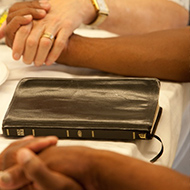

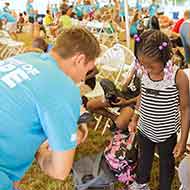 "I got new shoes, people!" says Maray, 5, whose four siblings had already received shoes and backpacks full of school supplies. At the Convoy of Hope Community Event in Wichita, Kan., churches and the community join together to meet needs. In preparation for the school year in Witicha, Kan., 1,246 Convoy of Hope volunteers served 5,406 guests of honor with 9,901 bags of groceries, 1,500 pairs of shoes, 1,150 backpacks full of school supplies, 592 haircuts, health screenings, dental work and more.
 "Are you prepared to die?" Billy Graham asks in the upcoming short film titled Heaven. Watch a 60-second preview of the My Hope 2014 video, releasing this fall, that features two inspiring life-and-death stories and a new message from Billy Graham on heaven. Then order a DVD copy to show your friends.
 The Department of Homeland Security Office of Health Affairs held an Ebola briefing for national faith leaders to provide current health and risk information to better assist faith leaders to inform their communities. The Christian Emergency Network (CEN) addresses lingering questions and concerns about the potential for Ebola affecting the U.S. and also gives suggestions for how Christians can get involved in praying, caring, and sharing hope in the midst of the crisis.
 The Church is responding to the crisis on the streets of St. Louis. Pastor Robert Loggins, Mission Metro St. Louis, shared that in the midst of the looting, escalating violence, finger pointing, and with media lights on full throttle, the Hope of Christ is shining ever brighter. "Jesus Christ is inspiring unity through the many prayer gatherings and is moving us toward acts of loving kindness toward each other, as well as toward the Brown family and all those who are confused and hurting," Loggins said. "We are able to put our arms around the anxious and the fearful with the Hope of God."
 National Back to Church Sunday is September 21. This is a campaign strategically designed to help churches reach out and invite everyone to try church again. This movement encourages church attendance by inspiring and empowering church members to invite their neighbors, friends, and loved ones to a special Sunday service designed just for them. In 2013, more than 23,100 churches participated in this growing national movement and on average saw a 31% increase in their attendance on that day. Read stories online about Back to Church Sunday experiences!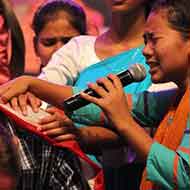
 As school begins in Norwalk, Iowa, Fellowship Community Church (FCC) welcomes the staff of the Norwalk Public Schools to an annual appreciation event at the church. The church hosts a lunch for all staff, including bus drivers, janitors, teachers, and everyone in between, that is prepared by the people of FCC. This event is part of a larger initiative the church calls Love Norwalk. This outreach includes a Christmas Angel Tree program, a Valentine's Day businesses appreciation, holiday services a 60,000-light synchronized lights and live nativity event in December, and more. Norwalk is a MAC Loving Our Communities to Christ city.
 Often we are focused on the sin of the lost, more than their need. "God dealt with sin for a purpose: to restore relationships-people to God and people to people. God's heart longs for relationship," writes Dr. David Ferguson in the Awakening America blog.